Discover why Elvis Presley, frustrated with Hollywood, channeled Marlon Brando’s iconic leather look in his groundbreaking 1968 comeback special.
Elvis Presley’s 1968 comeback is a pivotal moment in his career, and a new Netflix documentary, Return of the King: The Fall & Rise of Elvis Presley, gives fans an inside look at the man behind the music. While we remember the King of Rock for his music, his iconic comeback performance featured more than just his voice — it was a bold reinvention of his image. And a huge part of that transformation involved channeling none other than Marlon Brando.
Elvis’s Frustration with Hollywood: The Turning Point
By 1968, Elvis Presley’s career had hit a rough patch. Hollywood’s formulaic, cash-grab musicals left him feeling creatively stifled and disillusioned. The legendary singer confessed, “Hollywood’s image of me was wrong, and I knew it,” opening up about his frustration with playing the same roles in films like Double Trouble.
The documentary reveals just how emotionally drained Elvis was, and how much he longed for something more authentic. “I was obligated to things I didn’t fully believe in,” he says in the film, and this frustration helped fuel his decision to return to live performances after a seven-year hiatus.
Priscilla Presley Reflects on the ‘Crime’ of Hollywood’s Treatment of Elvis

Perhaps one of the most heartbreaking moments in the documentary is when Priscilla Presley reflects on a clip of Elvis performing “Old MacDonald Had a Farm” in Double Trouble (1967). Her voice filled with sadness, she says, “That to me is a crime.” She adds, “To put him in that situation and sing that song. It made him a laughingstock. And he knew it.”
While his early years in Hollywood had included hits like Jailhouse Rock, by the mid-1960s, Elvis was stuck in a cycle of forgettable films. His dream of being the next James Dean or Marlon Brando seemed further out of reach every year.
Elvis’s Bold Reinvention: The Marlon Brando Leather Look
So, how did the King of Rock plan to reclaim his throne? A key part of his reinvention came through fashion — and not just any fashion. Elvis turned to the style of one of his acting idols: Marlon Brando.
Producer Steve Binder stumbled upon a photograph of Elvis sitting on a Harley Davidson, clad in a leather outfit that screamed Brando’s The Wild One. Inspired by the image, Binder showed it to costume designer Bill Belew, asking if something similar could be created for Elvis’s comeback special.
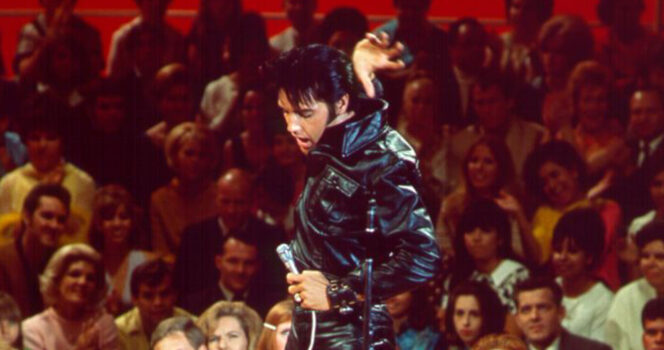
Belew, known for his visionary designs, crafted a custom leather suit with a high-collared jacket, soft silk shirts, and a neck scarf. This bold look wasn’t just for show — it was a statement. It was Elvis’s way of proving that he still had it, that he was back, and that he was reclaiming his place at the top.
The Iconic Leather Jacket: Symbol of a New Era for Elvis
The black leather ensemble Elvis wore during his 1968 Comeback Special became one of the most iconic outfits in rock and roll history. It symbolized more than just a fresh look — it represented Elvis’s return to the stage as a new, empowered version of himself. Despite the intense stage lights making the set incredibly hot, Elvis wore the suit with confidence, showing the world that he was back, and better than ever.
Binder and Belew hadn’t fully anticipated how hot the stage would get, but Elvis wore the jacket with trademark professionalism, proving that the discomfort of the heat didn’t matter. What mattered was that he was there, back in front of an audience, showing the world who he truly was.

The Comeback That Changed Everything
While the TV special’s soundtrack didn’t top the charts like his earlier hits, the success of the ’68 Comeback Special was undeniable. Elvis had returned to live performance in grand style, and the special revitalized his career. It also marked a major shift in how the world saw Elvis — not as a washed-up movie star, but as a passionate artist reclaiming his place.
“1968 was the biggest crossroads of Elvis’s life,” says director Jason Hehir in the documentary. “He used to have screaming teenage girls, but those teenage girls were now mothers.” The ’68 Comeback Special wasn’t just a return to music; it was a way for Elvis to show the world that he had grown — that he was more than the teen idol he had been in the ’50s.
A New Elvis, But Still Haunted by Hollywood
Despite the comeback’s success, Elvis’s relationship with Hollywood remained strained. While the TV special breathed new life into his career, his movie career never fully recovered. The damage done by the formulaic musicals of the ‘60s was too deep.
“We still don’t know what kind of actor Elvis could have become,” says Hehir. “His movie career just dried up. It was so mismanaged that he never got a chance to develop as an actor and demonstrate any sort of acting skills.”
But despite this, Elvis ultimately embraced what he truly loved — music. And the ’68 Comeback Special proved that the King of Rock was still a force to be reckoned with.