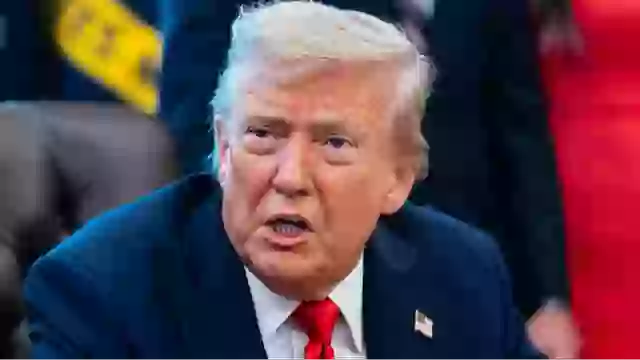
Donald Trump has stirred global tensions with his proposal to rename the Department of Defense to the Department of War. Is this an alarming move in the context of rising geopolitical conflicts?
Donald Trump has sparked alarm across the political spectrum after suggesting a controversial name change for the Department of Defense—proposing that it revert to its original title, Department of War. The statement came amidst rising geopolitical tensions, particularly with Russia’s ongoing conflict with Ukraine, and has led many to speculate about its implications for U.S. foreign policy and global security.
A Shocking Suggestion from the Oval Office
While speaking to reporters on August 25 in the Oval Office, Trump made his bold suggestion:
“We want to be offensive, too, if we have to be.”

This comment came after he praised Defense Secretary Pete Hegseth, referring to the Department of Defense as the Department of War. Trump went on to say:
“You know, we call it the Department of Defense, but between us, I think we’re going to change the name.”
The suggestion that the U.S. should return to the Department of War dates back to the post-World War II era, when President Harry Truman reorganized military services and created the Department of National Defense to enhance national security. In 1947, it was formally changed to the Department of Defense.
Q: "On the Department of War, how do you plan to do that? It requires an act of Congress to rename the Defense Department…"
President Trump: "We're just going to do it. I'm sure Congress will go along if we need that…Defense is too defensive. We want to be defensive, but we… pic.twitter.com/tfj3jhGVhY
— CSPAN (@cspan) August 25, 2025
The Call for More Aggressive Stance
Trump argued that the current name, Department of Defense, is too passive, stating:
“Defense is too defensive. We want to be defensive, but we want to be offensive, too if we have to be.”
The remarks come at a time of heightened concerns over global military tensions, with Russia and Ukraine at the forefront of discussions, making some wonder if this push for a name change signifies a shift in U.S. military strategy or rhetoric.
Public and Political Reactions
The response to Trump’s remarks has been mixed. While some argue that the name change would be honest and reflective of America’s historical role in global conflicts, others warn that it could be a dangerous and unnecessary rebranding that fuels fears of escalating war.
One commenter pointed out the political implications, saying:
“One portrays that we’re in wars, the other portrays that we will defend ourselves!”
Others voiced concerns over the rebranding process, with one critic stating:
“It was renamed that by Congress. So if he wants to change it, he can head back over there.”
This debate highlights the tension between those who believe in a more aggressive approach and those who fear the consequences of further militarization of U.S. politics.
The Bigger Picture: Global Tensions and U.S. Military Policy
The global security landscape is already fraught with uncertainty, with the ongoing conflict between Russia and Ukraine and the growing focus on potential U.S. involvement. Critics of Trump’s comments worry that such a move could be interpreted as an escalation in rhetoric, making it more difficult to find diplomatic solutions to international crises.