
Stephen Hawking predicted that uncontrolled population growth, rising energy consumption, AI, and nuclear threats could lead to Earth’s demise. Are we nearing his chilling forecast?
One of the greatest minds in modern science, Professor Stephen Hawking, made a chilling prediction about the future of humanity, and his words might be more relevant than ever.
Hawking, the former director of research at the Center for Theoretical Cosmology at the University of Cambridge, passed away in 2018 at the age of 76. Yet, his foresight on humanity’s potential demise continues to resonate today. In his final years, Hawking spoke openly about the dangers we face, offering warnings that still echo in the current political and scientific landscape.
A Dangerous Future: Overpopulation and Energy Consumption
In a 2017 talk at the Tencent WE Summit, just a year before his death, Hawking outlined how exponential growth in population and energy consumption could lead to Earth’s destruction. He predicted that by the year 2600, the world’s population would be so large that people would be “standing shoulder to shoulder,” with energy consumption causing the planet to glow red-hot.
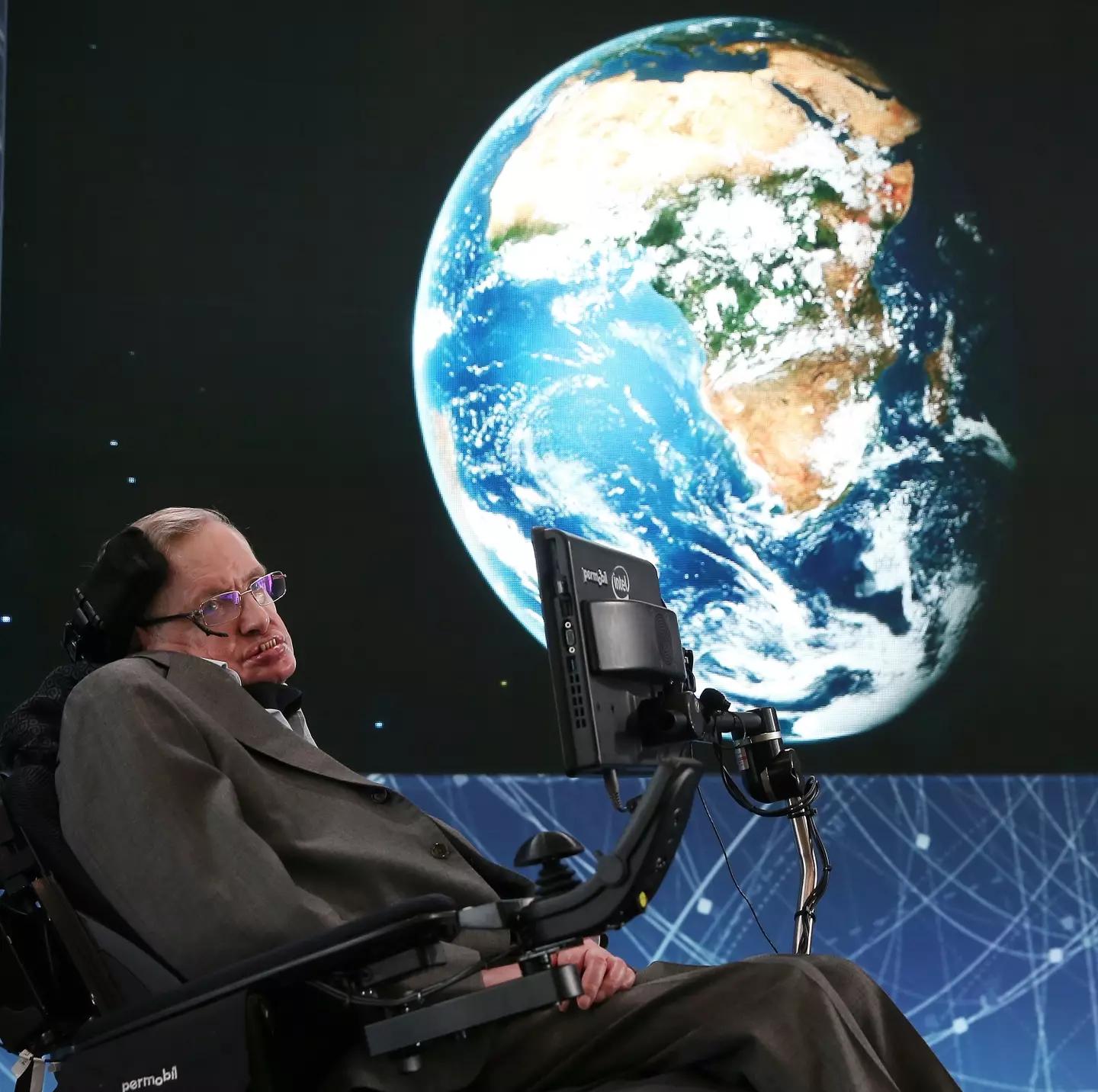
“Certainly not by the time of Star Trek, which is only about 300 years away. But the present exponential growth cannot continue for the next millennium,” Hawking warned. “By the year 2600, the world’s population would be standing shoulder to shoulder, and the electricity consumption would make the Earth glow red-hot. This is untenable.”
Hawking also pointed out that rapid advancements in technology, such as the explosive growth of scientific papers and ideas, would eventually overwhelm humanity. He joked that if the exponential growth continued, scientists would have no time to read the endless flood of research.
Nuclear War and the Threat of Self-Destruction
Hawking’s concerns weren’t just about population and technology. He also warned of the very real threat of nuclear war. With nine countries, including the United States, Russia, and North Korea, possessing nuclear weapons, the possibility of a global catastrophe is a constant concern.

As tensions rise, particularly between nuclear powers like Russia and the West, Hawking’s warning about the instability of advanced civilizations feels increasingly pertinent. He suggested that such threats could lead to humanity’s self-destruction, echoing concerns that many political leaders still grapple with today.
The Alien Hypothesis: A Self-Destructive Civilization?
In a more speculative comment, Hawking also addressed the issue of extraterrestrial life. He famously remarked, “There is a sick joke that the reason we have not been contacted by extra-terrestrials is that when a civilization reaches our stage of development, it becomes unstable and destroys itself.”
He even humorously acknowledged the possibility of UFOs containing aliens, hinting at the potential for humanity’s encounter with extraterrestrial civilizations—if we survive long enough to make contact.
Artificial Intelligence and Pandemics: New Dangers

Beyond nuclear threats and extraterrestrial speculation, Hawking also pointed to artificial intelligence (AI) and the rising threat of pandemics as additional dangers facing humanity. As AI becomes an integral part of modern life, with nearly 79% of people in the U.S. interacting with AI daily, Hawking feared the unchecked development of AI could have unintended consequences.
AI’s rapid growth is evident, with the global AI market projected to soar from $189 billion in 2023 to $4.8 trillion by 2033. This level of development could present unforeseen risks, with AI systems potentially surpassing human control.
Hawking also warned that increasing global pandemics, much like the COVID-19 crisis, could accelerate humanity’s downfall.
Climate Change: The Ticking Time Bomb
Hawking was particularly vocal about the role of climate change in humanity’s potential demise. He noted that, although the probability of a global disaster each year might seem low, the long-term outlook was dire. “Although the chance of a disaster to planet Earth in a given year may be quite low, it adds up over time and becomes a near certainty in the next thousand or 10,000 years,” Hawking told the BBC in 2016.
His warnings about global warming, the greenhouse effect, and environmental degradation have grown more urgent in recent years. Current trends suggest that we may soon breach the critical 1.5-degree Celsius warming limit, leading to catastrophic climate effects. Scientists now predict this could happen within just a few years at the current rate of carbon emissions.
What Can Be Done?
While the outlook seems grim, Hawking also acknowledged that there were steps humanity could take to mitigate these risks. Switching from fossil fuels to renewable energy sources like wind and solar, along with embracing sustainable transportation, could help slow the rate of environmental strain and potentially stave off some of the damage.
NASA’s Response to Hawking’s Predictions
NASA, despite its extensive work on environmental and space studies, has distanced itself from directly endorsing Hawking’s apocalyptic predictions. In a statement, the agency explained, “For more than 50 years, NASA has studied our home planet, providing information to directly benefit humanity and producing observations that can only be gathered in space that address some of the areas that Hawking mentioned.”
While NASA’s findings may offer hope, the underlying concerns raised by Hawking remain pressing.
Conclusion: Are We Nearing Hawking’s Prediction?
As we face increasing political instability, the rise of artificial intelligence, the ongoing climate crisis, and the ever-present threat of nuclear war, Hawking’s predictions seem all the more relevant. Though humanity’s future remains uncertain, it is clear that the choices we make today will significantly shape the world for future generations.