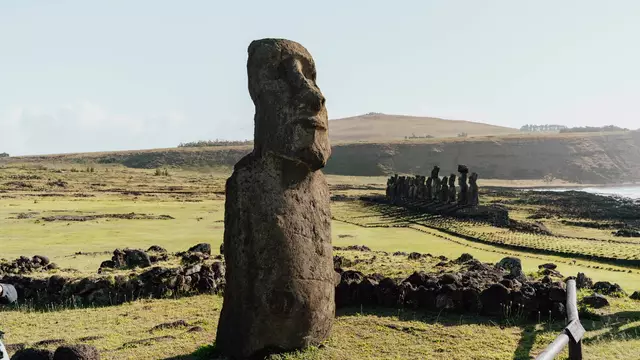
Scientists have cracked the mystery of how the Moai statues on Easter Island were moved. Learn how ancient Polynesians used a rope and pulley system to transport the massive statues across the island.
The enigma of how the massive Moai statues on Easter Island were transported has baffled scientists and researchers for centuries. But now, after years of study and experimentation, scientists believe they have finally uncovered the solution to this ancient mystery.
For decades, the 12-14 ton statues, known as Moai, have intrigued historians and archaeologists alike. While the Moai are widely recognized for their giant heads, many of them are full-bodied statues. The Rapa Nui people of eastern Polynesia created them between 1250 and 1500, but how these massive structures were moved across the island remains a question that has long remained unsolved—until now.
The Mystery Behind the Moai Statues
Easter Island, located off the coast of Chile, is home to over 800 Moai statues, each one weighing up to 14 tons. Despite being a marvel of ancient artistry, the question of how the island’s inhabitants moved such heavy statues has puzzled experts for centuries. With no written records from the time, it has been unclear how the Rapa Nui people managed to transport the massive stones without modern technology.
In the past, various theories were proposed, from sleds and rolling methods to the idea that aliens helped lift the statues. But now, new research suggests a simpler—and much more ingenious—method.
The Discovery: Using a Rope and Pulley System
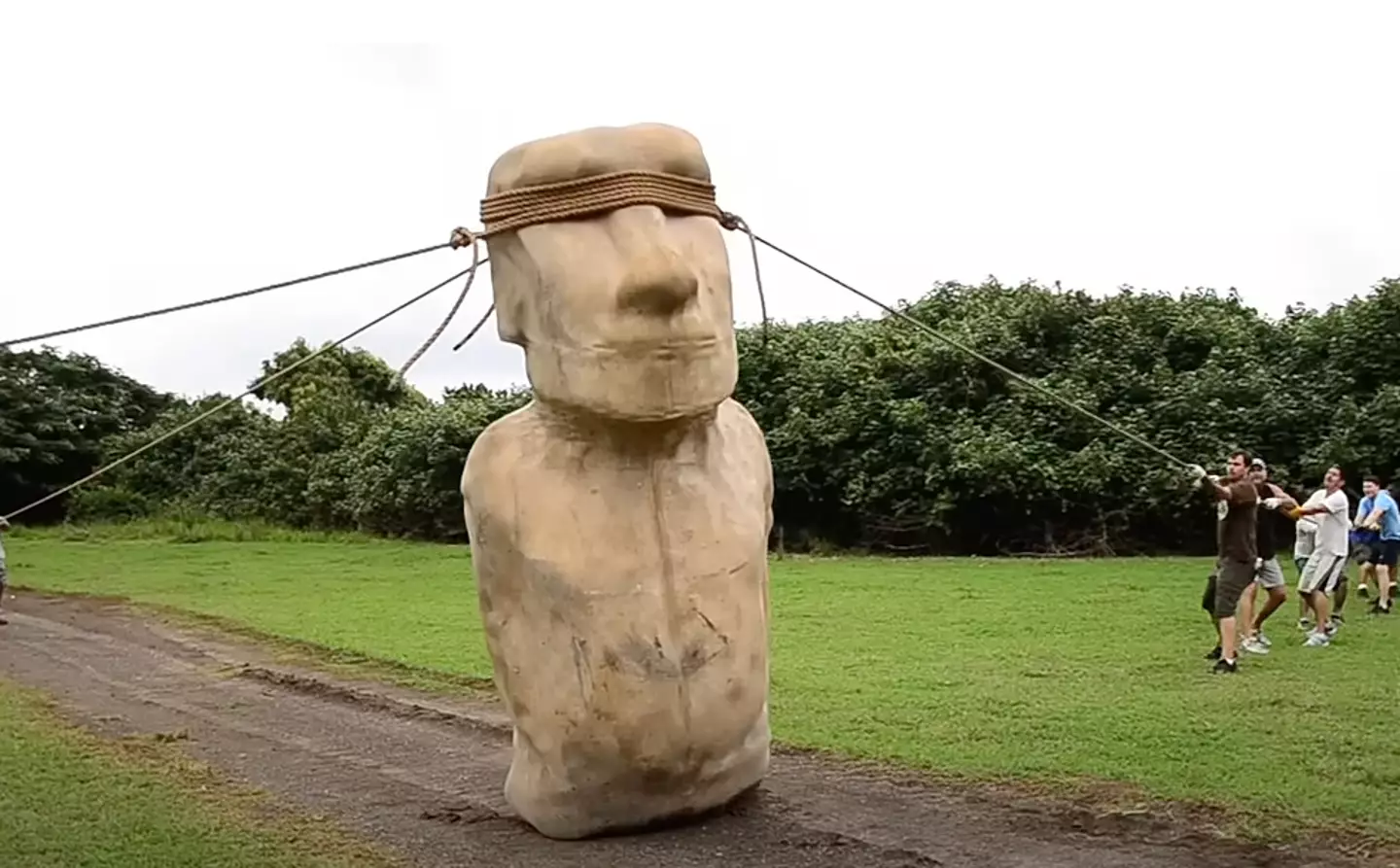
Binghamton University Professor of Anthropology Carl Lipo, along with Terry Hunt from the University of Arizona, have spent years studying the Moai statues. After conducting experiments and simulations, they believe the Rapa Nui people used a sophisticated rope and pulley system to “walk” the statues across the island.
Lipo explains that once the statues were set in motion, it was relatively easy to move them with minimal effort. “Once you get it moving, it isn’t hard at all – people are pulling with one arm. It conserves energy, and it moves really quickly,” he said. “The hard part is getting it rocking in the first place.”
Experimenting with a Replica Moai
To test this theory, the researchers built a 4.35-ton replica of a Moai statue and conducted their own experiment. Using a team of just 18 people, they successfully moved the replica statue 100 meters in just 40 minutes. The process involved using ropes and coordinating the movement in a way that mimicked the “walking” motion. The results were consistent with their hypothesis.
“The physics makes sense,” Lipo remarked. “What we saw experimentally actually works. And as it gets bigger, it still works. All the attributes that we see about moving gigantic ones only get more and more consistent the bigger and bigger they get because it becomes the only way you could move it.”
The Role of Easter Island’s Roads
The researchers’ theory is further supported by the layout of Easter Island’s roads. Lipo explains that the island’s pathways and roads seem to have been deliberately constructed to accommodate the moving of the Moai statues. “What they are probably doing is clearing a path, moving it, clearing another, clearing it further, and moving it right in certain sequences,” Lipo said. “So they’re spending a lot of time on the road part.”
This idea of moving the statues in sequences along cleared roads makes sense with the findings from the experiment and provides a clearer understanding of how the Moai were transported across the island.
A Bold Challenge to Critics
Lipo and his team are confident in their findings, so much so that Lipo has issued a challenge to anyone who disagrees with their theory. “Find some evidence that shows it couldn’t be walking,” he said. “Because nothing we’ve seen anywhere disproves that.”
This bold assertion has sparked further interest in the mystery of Easter Island, and while some skeptics may remain, the evidence now points strongly toward the Rapa Nui people’s use of a rope and pulley system to move the colossal Moai statues across the island.
Conclusion: Solving an Ancient Mystery
After centuries of speculation, scientists have provided a plausible and scientifically backed solution to how the Moai statues were moved across Easter Island. Using ropes, pulleys, and a coordinated system of “walking” the statues along cleared roads, the Rapa Nui people demonstrated an impressive understanding of physics and engineering that has now been revived in modern research. The mystery of the Moai statues may be solved, but the ingenuity of the ancient Rapa Nui people continues to amaze.