Donald Trump sparks controversy after claiming he has the right to do “anything I want” as President. Critics say his statement undermines the Constitution.
Donald Trump is facing intense criticism after a recent statement where he appeared to claim that, as President, he has the right to do “anything I want.” This remark has led some to argue that it represents a violation of his presidential oath and a disregard for the Constitution.
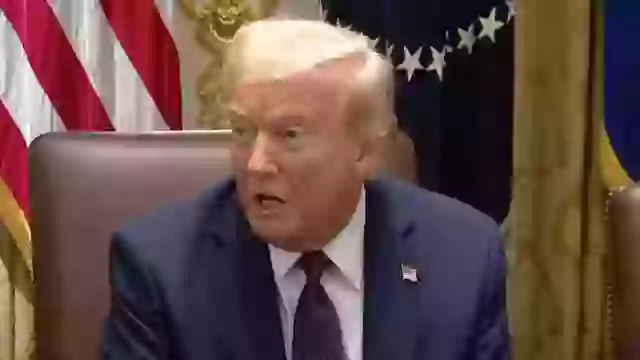
The controversy stems from Trump’s comments during a press briefing in the Oval Office, where he discussed the growing crime in cities like Chicago and New York. He proposed the idea of deploying the National Guard to these cities to tackle what he described as “crime, bloodshed, bedlam, and worse.”
A Power Play or Overreach?
Trump has already used the National Guard in Washington D.C. to address crime-related issues, and he suggested that Chicago and New York could be next on his list. His comments came after Illinois Governor JB Pritzker criticized Trump’s remarks, asserting that there was no emergency in Chicago that would justify the use of federal troops.
In response, Trump hit back at Pritzker, saying:
“You have a guy in Illinois, the governor of Illinois, saying that crime has been much better in Chicago recently and Trump is a dictator. Most people are saying, ‘If you call him a dictator, if he stops crime, he can be whatever he wants.’ I am not a dictator, by the way.”
Later, Trump went even further, stating:
“Not that I don’t have… the right to do anything I want to do. I’m the president of the United States. If I think our country is in danger — and it is in danger in these cities — I can do it.”
This statement raised alarms about the extent of executive power and whether the President can unilaterally make decisions without following constitutional checks and balances.
A Violation of the Presidential Oath?
Many critics argue that Trump’s declaration undermines his presidential oath, which requires him to “faithfully execute the Office of President” and “preserve, protect and defend the Constitution of the United States.” By claiming that he can act without restrictions, Trump seems to disregard the constitutional limits on presidential power.
According to the Harry S. Truman Library, the President does not have the authority to make or interpret laws, declare war, or act unilaterally on matters such as military deployment without approval from Congress or other governing bodies.
This recent remark from Trump has led many to say that his approach to power resembles an authoritarian mindset, where the will of one person overrides the checks and balances of a democratic system.
Political Fallout and Criticism
Governor Pritzker wasted no time in responding, calling Trump’s comments “dangerous” and a “power grab”. He stated:
“Donald Trump wants to use the military to occupy a US city, punish his dissidents and score political points. If this were happening in any other country, we would have no trouble calling it what it is — a dangerous power grab.”
Senators from Illinois, including Dick Durbin, joined in the condemnation. Durbin called Trump’s statements “purely political theatre,” while Tammy Duckworth, a retired Army National Guard lieutenant colonel, described them as “deeply disturbing” and “un-American.”
Duckworth added:
“It’s yet another unwarranted, unwanted, and unjust move straight out of the authoritarian’s playbook that will only undermine our military’s readiness and ultimately weaken our national security.”
Defenders of Trump’s Statement
While the backlash against Trump has been significant, some have defended his position. Supporters argue that, as Commander in Chief, the President does have the power to deploy military forces if national security is at risk, including addressing crime in U.S. cities.
One supporter on X (formerly Twitter) wrote:
“Trump is right. As the president, he is the commander in chief and can deploy the military anywhere.”
However, others disagreed, stating that “you do not have the right to do anything you want,” adding that the President must respect the limits of his constitutional powers.
The Constitution and Limits of Presidential Power
Critics argue that Trump’s words reflect a misunderstanding of the Constitution’s limits on presidential power. One person pointed out:
“The entire document [the Constitution] was designed with the specific, singular purpose of preventing any one person from having ‘the right to do anything I want.’ This isn’t an interpretation of presidential power; it’s a public declaration of its abolition.”
Trump’s remarks have once again sparked debate about the balance of power between the executive branch and the legislative branch, as well as the importance of maintaining the checks and balances that prevent any one individual from becoming too powerful.
Conclusion: A Dangerous Precedent?
Trump’s controversial statement has brought into focus the ongoing debate over the extent of presidential power in the United States. His claim that he has the right to do “anything I want” has many wondering whether it signals a dangerous shift toward authoritarian rule, or whether it’s simply another example of Trump’s rhetorical style.
Regardless of where one stands politically, it’s clear that executive overreach is a critical issue in any democracy, and the conversation about the role of the President in protecting the Constitution is far from over.